
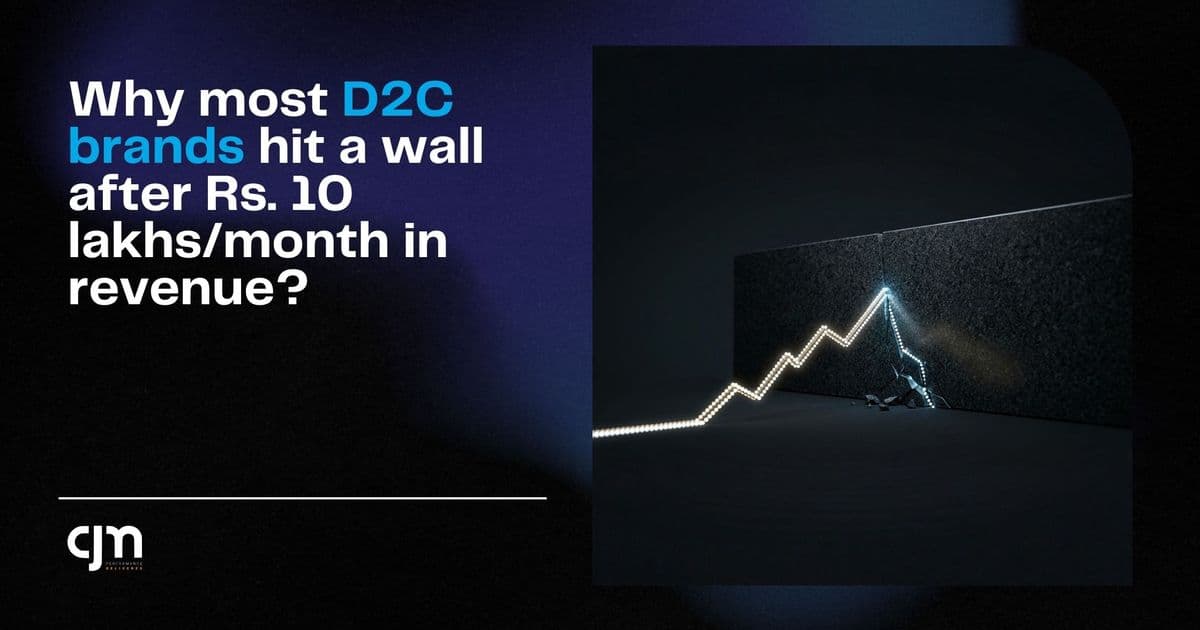
Why Most D2C Brands Hit a Wall After Rs. 10 Lakhs/Month in Revenue
Aditya
Author
Article Content
I talk to D2C founders almost every day. And there's this specific moment that keeps coming up in conversations — usually somewhere around the 8-12 lakhs/month revenue mark.
"Bro, we were growing 30-40% month over month. Now we're stuck. We increased ad spend but ROAS dropped. We tried new creatives, new audiences, new platforms. Nothing's moving."
If this sounds like you, keep reading. Because the problem isn't your ads.
The Uncomfortable Truth About Early Traction
Here's what nobody tells you when you launch a D2C brand. That initial growth? A lot of it is fake. Not fake as in the numbers are wrong — but fake as in it's not sustainable.
Your first few lakhs in revenue come from:
Friends and family buying (they would've bought anything you launched)
The launch buzz — that initial spike from social media posts and PR
Your warmest audiences on Meta — the algorithm finds easy wins first
Low competition for your brand keywords on Google
Founder-driven sales hustle that doesn't scale
None of that is repeatable at 3x or 5x the scale. The algorithm runs out of easy audiences. Friends stop buying. The buzz fades. And suddenly you're competing for cold traffic against brands with deeper pockets and better systems.
The 4 Things That Actually Break
1. Unit Economics Were Never Real
This is the big one. Most early-stage D2C brands have no idea what their real unit economics look like. They know their product cost. They roughly know their ad spend. But they're ignoring:
Return/exchange costs (in fashion, this can be 20-30% of orders)
Packaging and shipping (which keeps going up)
Payment gateway fees
COD failure rates (10-15% is normal in India)
Warehouse and operations costs
The founder's time (which has a cost even if you're not paying yourself)
I've seen brands celebrating a 3x ROAS who were actually losing money on every order once you factored in returns and COD failures. You can't scale a loss. Well, you can — but it ends badly.
2. No Repeat Purchase Strategy
If your business depends on acquiring a new customer for every single sale, you're on a treadmill that speeds up while you get tired.
Acquisition costs on Meta and Google go up every year. That's just the reality. The brands that survive are the ones where a customer who bought once comes back and buys again without being convinced through a paid ad.
We look at one simple metric: what percentage of your revenue comes from repeat customers? If you've been around for 6+ months and that number is below 15% — something is wrong with your product, your packaging, your experience, or your post-purchase communication. Fix that before you scale.
3. Creative Fatigue Hits Hard
Those 3-4 winning creatives that got you to 10 lakhs? They're cooked. The audience has seen them. Performance is declining. And you don't have a system for producing new ones.
At scale, you need to be testing 15-20 new creatives every month. That means having a content engine — UGC creators, a designer, a copywriter, someone editing reels. Most brands at this stage are still relying on the founder's phone camera and Canva. That worked at 2 lakhs/month. It doesn't work at 20.
4. Operations Can't Keep Up
You doubled your ad spend. Orders went up. But your packing team is the same 2 people. Shipping takes 5 days instead of 2. Customer complaints spike. Reviews go from 4.5 to 3.8 stars. And that tanks your ad performance because Meta's algorithm can sense when people aren't happy (return rates, complaint ratios, engagement drops).
Scaling revenue without scaling operations is like flooring the accelerator with a flat tyre. You'll go fast, briefly, and then crash.
What to Fix Before You Scale
Before you throw more money at ads, answer these honestly:
Do you know your real cost per delivered order? (Not CPO from Ads Manager — the actual number after returns, COD failures, and shipping)
Is at least 20% of your revenue from repeat customers?
Can you produce 15+ new ad creatives per month consistently?
Can your operations handle 2x the current order volume without quality dropping?
Do you have at least 3 months of runway if ROAS drops by 30%?
If you answered no to more than two of these, you're not ready to scale. And that's fine. It's better to fix the foundation than to pour money into a leaky bucket.
The Brands That Break Through
The D2C brands that actually cross 50 lakhs, a crore, and beyond — they all have a few things in common:
They obsess over product experience, not just marketing
They build email + WhatsApp lists and actually use them (owned channels, not rented ones)
They treat content as a growth lever, not an afterthought
They know their numbers cold — CAC, LTV, repeat rate, contribution margin
They hire for operations before they hire for marketing
None of that is sexy. It doesn't make for good Instagram carousels. But it's what separates the brands that last from the ones that burn bright for 8 months and then quietly shut down.
Bottom Line
Hitting a wall isn't failing. It means you've outgrown your current approach. The brands that treat this plateau as a signal to fix their fundamentals come out stronger. The ones that just increase ad spend and hope for the best... don't.
Fix your unit economics. Build retention loops. Create a content engine. Then scale. In that order.